Fast Battery Charging :
-
Most battery chargers are Constant Current ( CC ) by design i.e. they input a fixed current into the battery.
- Typically, they are set at Capacity/10. The denominator indicates the number of hours it will take to fully charge the battery. [ A 100 AH battery being charged at 10 A will take 10 hours to charge ]. - The other option is to use Constant Voltage ( CV ) chargers. The battery will charge at a fixed voltage and the current should ideally taper down.
- In both cases , of CC/CV chargers trying to input excess power into the battery causing damages. Need is to sense the voltage level and cut out the charge.
- The ideal charger should be one with the characteristics of both CC and CV
The Big Myth : Fast Charging damages the batteries.
For the answer, let us turn to the standard reference on Batteries, Linden's Battery Handbook. It says "The VRLA battery is capable of recombining the oxygen produced on overcharge up to the C/3 rate of constant current charge. At higher rates the recombination reaction is exceeded by the rate of gas generation."
To fully understand this statement you have to realize that no oxygen is generated during the charging of the battery. Oxygen is only generated when the battery is being overcharged. So even if you use the dumbest charger on the planet it won't cause the battery to vent.
Linden’s Handbook also discusses quick-charging in which he sets a constant voltage and lets the battery accept what charge it will. His conclusion is: "These data show that the thin-plate VRLA battery can be fast-charged to 100% of the rated capacity in less than 1 hour."
Basically, it is OK to charge a sealed lead acid battery fast as long as you don't overcharge it.
The Optixtal Fast, Intelligent Charger (O-FIC) :
The Optixtal Charger is a CC-CV (Constant Current – Constant Voltage) designed to ensure that when the battery is full, the applied voltage is less than the gassing voltage, and no damage can occur. Fast charging is crucial to the electric vehicle industry, and long battery life is essential, so a lot of the quick-charging research has been done for this application.
How does it work?
The O-FIC charges a 48 V battery at a constant current of 25 A. This means that an e Vehicle battery set of 80 AH can be fully charged in slightly over 3 hours and a 100 AH battery can be fully charged in 4 hours, a significant improvement over the 10 hours that most battery chargers currently take to fully charge.
When the battery is fully charged and cannot accept more current, the current drawn from the charger drops drastically.
Energy Input is the same as for a regular charger. Temperature increase of electrolyte is a maximum of 4 C .
( Brown line is Current , Blue Line is Voltage )
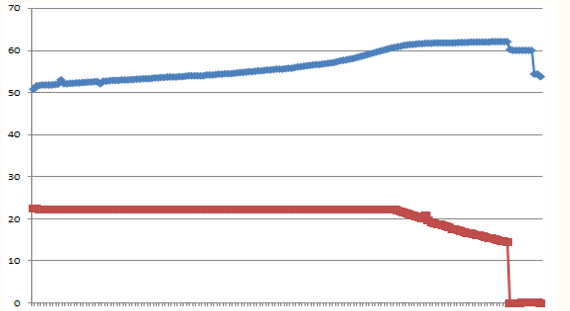
Graph : O-FIC charger
Implications for commercial eVehicle owner operators :
Commercial eVehicles cannot afford conventional slow charging.
In the case of eRickshaws, battery packs have increased from 80 AH to 150 AH, which implies the capital investment in batteries and the dead weight being carried around has effectively doubled.
Using O-FIC the battery can be charged to 80 % of its’ SoC ( State of Charge ) in 2 hours. This means the battery can be quickly topped up during the lean activity period, typically around the lunch hours.
Commercial Offering :
220 V input , single phase Intelligent, Fast Battery Charger typically used by an individual eRickshaw operator :
- Inputs 25 A Current at a tapering voltage.
- Wall Mounted
- Stand Alone Option for eRickshaw assemblers.
- Twin fan cooling
- Thermal shutdown
- Depth of charge status displayed by multiple LEDs
- Battery input: 4V x 12V tubular 88/100Ah
- Charging current: 2-stage charging with maximum current of 25A
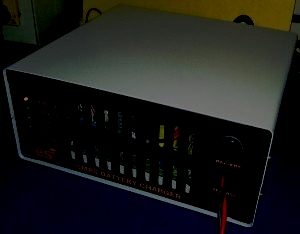
Battery charger